Posted on 4 Comments

Telepresence Killed Video Conferencing

I had seen commercials for telepresence technology, but was skeptical. It seemed like an unnecessary extravagance when simply video teleconferencing technology would suffice.

I was wrong.

Earlier today I participated in my first telepresence meeting. This Cisco technology puts your remote participants directly across the table from you. The sound quality is amazing, and the levels make the remote participants sound like they are actually in the same room. The sound even emanates from the location of the speaker; when the fellow on the left speaks, the sound comes from the left. It’s an immersive experience where you quickly forget that the folks across the table are actually across the Atlantic!

How does telepresence compare to traditional video teleconferencing? I’ve been in many of these video telecons, but they pale in comparison. Often the screen is so crowded and the people so small that you can’t tell who is talking. Sometimes it’s difficult to even distinguish who is who! They are a weak substitute for face-to-face meetings, but in a time where businesses are rightly watching their budgets, they have become a necessary evil.

In contrast, the telepresence technology is so immersive that when one of the remote participants dropped a sheet of paper, one of my local colleagues instinctively reached to pick it up, only to realize that it was thousands of miles away.

Effectively, Cisco TelePresence has killed old school video teleconferencing for me.
Posted on 1 Comment

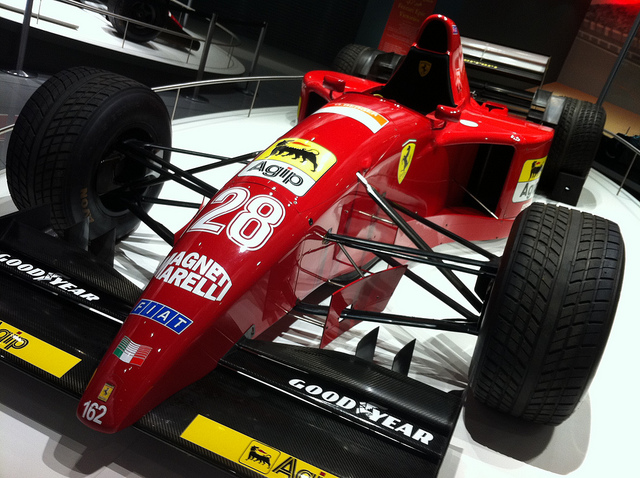
Adventures in Abu Dhabi: Ferrari World

Where else but in the UAE would you find the largest indoor amusement park — devoted to Ferrari — and the world’s fastest roller coaster? Nowhere else.

Saturday was my adjustment day in Abu Dhabi, having travelled eleven time zones from LA, arriving late Friday night. My colleague Tom and I ventured out to visit Ferrari World on the outskirts of town.  We looked forward to staking claim to riding the world’s fastest roller coaster – the Formula Rossa, which hits speeds of 240km/h.

Ferrari World is impressive in size and ambition, but the lack of crowds made us wonder how long it would remain open. For starters, three of the most popular attractions were closed for maintenance — including the world’s fastest roller coaster. Bummer.

We ambled over to the one roller coaster that was open, and were the first two in line. In fact, we were the only two in line. We had to ask to double-check that it was even open (it was). We navigated the serpentine (but empty) queue designed to handle mobs of people and made our way to the ride. We were the only ones on the first trip around the track. When we returned, there was still no line, so we went back. From there on, we didn’t even get off, we just asked them to keep sending us around. We rode it four consecutive times before finally a few people started to filter in.

The crowds did grow a bit over the afternoon, but it was never crowded. And we were both a little disappointed that three of the key attractions were closed (not a good sign).

On the bright side, I did learn a lot about Ferrari and saw some beautiful cars – some historic and many new models. But the experience left me scratching my head and wondering about the business viability of the park.

And while I can’t claim to have ridden the world’s fastest roller coaster, I may be able to say… “I visited Ferrari World back when it was still open.”

All this got me thinking; putting aside questions about whether it’s the right thing to do or not, let’s assume that the objective is to make changes that would help Ferrari World thrive. What changes would help them grow?

One obvious omission was the lack of a Ferrari dealership. Let qualified buyers test drive a Ferrari on the adjacent Formula 1 track (the Yaz Marina Circuit). Let people pickup a new car brochure and dream a bit. Even though the car’s price puts it out of range for most people, I was shocked that this wasn’t there. The “world” was a bit incomplete. You couldn’t even find out how much they cost (at least, it wasn’t apparent).

How would you crank up the buzz and stimulate business?


Posted on Leave a comment

Starbucks, The New Logo and The Real Customer

It’s been said that there are two kinds of people in the world; those that divide the world into two kinds of people, and those that don’t. I do.

And so…

There are two kinds of people in the world. Those that like Starbucks, and those that don’t. I love Starbucks.Yes, it’s pricey, but I usually visit my local Starbucks on El Camino two or three times a week. My girlfriend would probably guess more frequently, but I’m not ready to admit to that.

[blackbirdpie url=”http://twitter.com/#!/jeffhester/status/45861891599368194″]

This week Starbucks is celebrating their 40th anniversary. Regardless of what you think of their coffee, you have to respect that they’ve done a few things quite well from a business perspective. In conjunction with their 40th anniversary, they rolled out their new logo. It’s not really all that new — but more of a modification. Essentially they stripped out the band with the text that read “Starbucks Coffee,” leaving only the siren.

There was an uproar when they announced the new logo back in January. Some of my designer and marketing friends were up in arms over the new design. “Big mistake” was the consensus. Now that it’s here, I don’t hear much from anyone. Certainly it didn’t seem to reduce the morning lineup at Starbucks. It didn’t confuse, confound or bother the average customer at all. Either they didn’t notice, or didn’t really care. If they did notice, it was a novelty — “Oh, look! They changed the logo!” A sort of positive vibe that keeping it fresh provides the brand.
Mark Hurst profiled Starbucks in last week’s Good Experience newsletter. He notes that the formula that drove success at Starbucks began to falter a couple years ago, but they’ve appeared to turn this around. CEO Howard Schultz explained to the Wall Street Journal how they turned things around. “Putting our feet in the shoes of the customer…” was his key message. Note that the average customer wasn’t bothered by the logo change. The noise generated by the design and branding community was simply that — noise.

Last week at Linked OC, Seth Godin shared an interesting anecdote about Starbucks. He noted that when they originally opened, they did not sell coffee. They sold coffee beans, but not coffee by the cup. The formula faltered until they brought in a new CEO who brought in the idea of serving espresso drinks such as he had seen in Italy, and the rest is history.

Where is all this headed? Well, we’ve established that I like Starbucks. Two out of my three offspring have worked for Starbucks (one still does). And Starbucks, in spite of all their success was not and is not immune to mis-steps, either. The key has been, and remains — keeping the customer in mind.

So then, who is your customer? And are they on your mind?

Posted on 5 Comments

Seth Godin Pokes the Box

Last night I had the pleasure of hearing best selling author Seth Godin speak at this month’s LinkedOC event in Segerstrom Hall. Godin’s talk centered around the subject of his latest book, Poke the Box, in which he encourages us to take initiative; to instigate; to GO! Writes Godin:

“Imagine that the world had no middlemen, no publishers, no bosses, no HR folks, no one telling you what you couldn’t do.

If you lived in that world, what would you do?

Go. Do that.”

Godin is a terrific speaker, very relaxed and personable as he skillfully balances enlightenment and entertainment. I won’t repeat his talk (Ricardo Bueno put together a great recap), as you can get even more from his book. What really intrigued me was the Q&A afterwards, particularly when he described his Domino Project.

What is the Domino Project?

The question came from the audience after his talk. Seth spoke passionately about how he felt the publishing industry has lost it’s way. “Bookstores are dead,” Godin boldly declares. Not dying. Not hurting. Just dead. So he partnered with Amazon, who happens to sell a few books directly to consumers, and has some interesting data about those sales.

From Amazon, Godin learned that a majority of sales of his last best seller were to customers who bought in multiples — two, three, five or more copies of his book. Godin’s books are unique not only for their content, but their form factor. They are small, compact packages that can easily be absorbed in a long plane flight and passed on to a friend, making them well-suited for multiple purchases.

The Domino Project changes the formula. Instead of publishers selling to bookstores (who aren’t really the customer), Godin leverages Amazon to sell directly to consumers. Instead of one size fits all, you can order Poke the Box in no less than ten different formats and packages. You can get the Kindle version for a mere $4.99, or a pack of 52 hardcover versions for $341 (and everything in-between).

Godin even points out the the front cover of the book has no text on it. No title, author or marketing speak. Just a clever, retro-looking chap who looks excited. A colleague or friend who spies it sitting on your table is compelled to inquire “what is this?” Godin’s austere cover is irresistible book bait.

It’s still to early to tell whether Godin’s gamble will be a success, but I’m betting he’s at least on the right track. He says that early sales figures are 5x that of his last best-selling book.

With his Domino Project, Seth Godin is practicing what he preaches in Poke the Box.

What box are you poking?

Posted on 1 Comment

Face-to-Face Still Matters

Earlier today we wrapped up three consecutive days of video teleconferences to train five new knowledge managers. The trainees were located in Greenville, Calgary and Houston, while the other trainers and I were primarly located in Southern California. In better economic times, our trainees would have travelled to Southern California for the week,  spending some serious face time not only with those of us leading the training, but with most of the core KM team.

This face-to-face KM immersion did two things:

First, it allowed them to focus on what they where learning, without the distractions of the everyday office activities around them. Sitting and working side-by-side with the KM team gave them an opportunity to really absorb a great deal of knowledge that wasn’t necessarily a part of the training outline.

But the second, and even more important result was the relationships that were built. In most cases, this gathering was the first time we worked together. In addition to spending most of the work week together, we would eat lunch together and even go out afterwards for dinner or go sailing. The bond that formed provided a solid foundation for an ongoing working relationship. They felt comfortable coming to us because they knew us well. They trusted us, and knew we were there to help them. They understood the gravity of their new role as knowledge managers. They reached out for help or to brainstorm solutions for integrating knowledge management into their community’s work processes, and gladly participated when we asked them to help us with an enterprise KM initiative.

Doing this via video teleconference has required a change in approach. Sessions are shorter, with more pre-reading and pre-work. There are exercises that require multiple touch points with the KM team, ensuring that they will talk with someone on the team on a fairly regular basis. Will this suffice? Not a chance.

Fellow KM-er David Gurteen recently shared a great article on Harvard Business Review via this tweet:

[blackbirdpie url=”https://twitter.com/#!/davidgurteen/status/38593360214106112″]

In his article Why Face-to-Face Meetings Make All the Difference, Stephen Greer describes how use used face-to-face meetings to build and strengthen relationships with his leadership team. Greer concedes that after the relationships had been established, he was able to reduce the frequency of meetings, and conduct more of them remotely.

“Over time, once personalities gelled and relationships bonded, we were able to scale back the frequent flyer miles by making it a quarterly face-to-face meeting, with monthly conference calls in between. Today a videoconference would be the preferable alternative, as technology is definitely bringing distant operations closer together.”

Note that he didn’t jump straight away to conference calls. He notes that it took time to build and bond relationships with face-to-face meetings. Only after those relationships were bonded could they scale back the frequency and begin leveraging alternative technology like video teleconferencing.

Yes, face-to-face still matters.

The challenge is this: What do you do when face-to-face is not an option? How do you build those relationships that are necessary to create trust between people who don’t really know each other that well?

Posted on 1 Comment

Things Real People Don’t Say About Advertising

Things Real People Don’t Say About Advertising is a Tumblr-powered collection of cheesy stock photos poking fun at the world of advertising… and advertisers too-often disconnection with reality. It’s a breezy, easy site to scan, in much the same way as the Lolcats at I Can Has Cheezburger.

While it’s sure to make you smile, especially if you’ve been involved in advertising or even commercial web projects, TPDSAA has a very real point. Too often we miss the mark when trying to communicate. We spend too much time on minutiae, and make too many assumptions that “we” know what our audience wants because we think they are just like us.

We Are Not Our Audience

Whether “we” means an ad agency, design firm or an individual simply trying to stake their claim on the Internet, “we” are not the same as everyone else. In fact, everyone else is very different from us. We are too close to the subject to see it through the eyes of the average visitor.

Over and over I’ve heard anecdotes of people recruiting their mom as the ultimate usability tester. The assumption is, if mom gets it, everyone will. Honestly, this is not far from the truth. We need to interact. We need to be genuine. We need to ask — our visitors, employees, members or customers — what they really need and want. And then, we need to give it to them.

I’m not suggesting design by committee, or worse, design by community. There is still a need for vision and creativity. Our experience and knowledge can help create a user experience that delights. Doing so requires a combination of that know-how and a willingness to listen and adapt to genuinely serve the audience.

Check out TPDSAA. I guarantee you will find at least a few photos you’ll relate to. And if you’re in a position to influence user experience, think about how you can avoid ending up lampooned on TPDSAA.

Looking to improve user experience? Here’s two companies I recommend:

  • Adaptive Path provides a range of consulting services to help companies improve their user experience, as well as coordinating a series of events and conferences for user experience professionals.
  • Creative Good also provides consulting services for companies who want to improve the user experience, supplemented by councils — groups of peers sharing their knowledge and expertise. The annual GEL conference (Good Experience Live) draws a range of creatives in a format closer to TED than an typical conference.

Meantime, I’m thinking about how I can apply the humor of TPDSAA to the realm of knowledge management. Stay tuned…

Posted on Leave a comment

Seth Godin Returns to Orange County

Seth Godin is coming to Orange County! Godin’s twelve books — all of them bestsellers — deal with the post-industrial revolution, the way ideas spread, marketing, quitting, leadership and most of all, changing everything. His blog is considered the most popular marketing blog in the world. And he’s coming to Orange County and you can hear him speak.

On March 2, Seth will be speaking at Renée and Henry Segerstrom Concert Hall. The event — organized by Bryan Elliot as part of Linked Orange County — is a great opportunity to hear from the innovative thought leader who usually is only seen at exclusive events like TED. Tickets are available now, and this is likely to sell out.

I’ve read several of his books, including The Big Moo, Small is the New Big, and Linchpin. He has a way of cutting through the crap and addressing your customer (be they internal or external) in a whole new way. Check out all of Seth Godin’s books (affiliate link).

What’s your take on Seth Godin? Let me know if you going on March 2, and I’ll make a point to say hello.