Posted on 12 Comments

Visualize Your Professional Network with InMaps

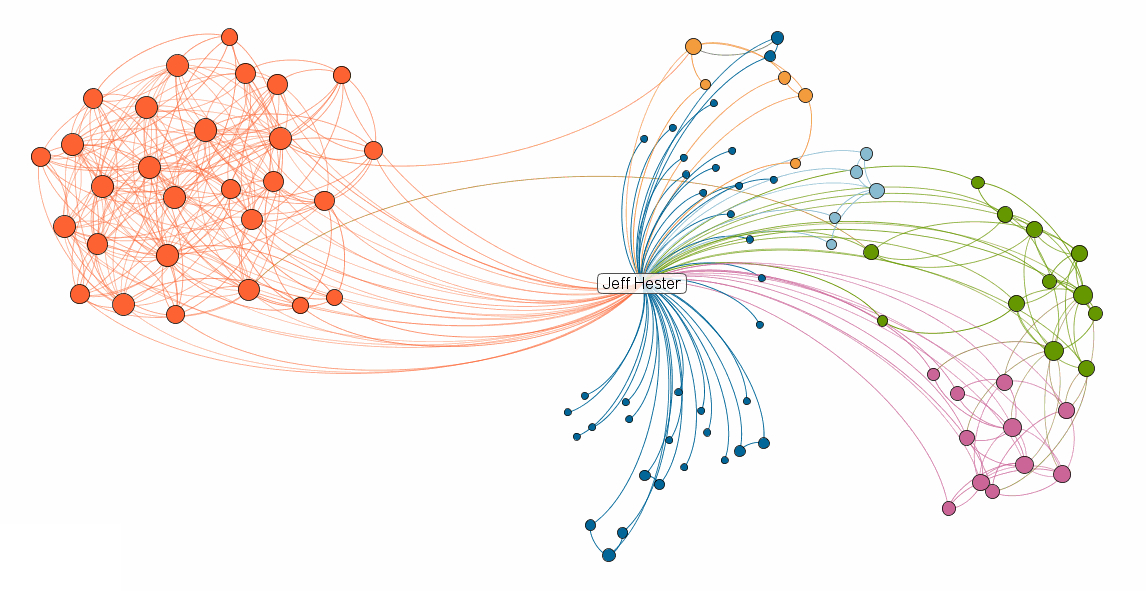
LinkedIn Labs has introduced InMaps – a visualization of your LinkedIn network. I first heard about InMaps via a Tweet from fellow #SMMOCer Mel Aclaro. LinkedIn wisely made sharing easy, and so a quick search will find plenty of fresh tweets about this as people discover the new feature.

I gave InMaps a quick spin and quickly discovered LinkedIn’s not-so-subtle ulterior motive: You can’t create a visualization unless you have at least 50 connections and your profile is at least 75% complete.

I’ll bet you a cold beverage that LinkedIn enjoys an sudden surge in both profile completion and network connections as a result.

For LinkedIn, it’s a brilliant move. By offering something sexy that people want (the groovy diagrams) but requiring them to step up and engage on a deeper level, the entire network wins. And (theoretically) they drive the behavior that they want from their community — people sharing deeper knowledge about their experience and connections.

How can we bring change to our community/organization/business/world? One small incentive at a time.

If you care, you can check out my visualization, create your own, or connect with me on LinkedIn.

Posted on 4 Comments

Planning, Goals and Success

“There’s no difference between a pessimist who says, “Oh it’s hopeless, so don’t bother doing anything.” and an optimist who says, “Don’t bother doing anything, it’s going to turn out fine anyways. Either way, nothing happens.” – Yvon Chouinard, rock climber, environmentalist and founder of Patagonia

“Failures don’t plan to fail; they fail to plan.” Harvey MacKay

“A goal without a plan is just a wish.” Antoine de Saint-Exupery

These quotes share a common thread and illuminate a problem that is far too common. I see it in companies struggling to implement knowledge management. I see it in communities of practice. You can find it in businesses, organizations, clubs, and even the personal lives of people we care about.

The problem? The absence of a plan.

Historically — and with comic certainty — the gyms overflow in January as we collectively resolve to shed those holiday pounds and get healthy. By the end of the month, the crowd subsides and it’s back to business as usual. What happens? Do people decide that they really don’t want to lose the weight they tacked on? Do they discover that their health really isn’t that important to them? No, the problem is that they have a goal in mind (i.e. lose weight), but only a vague idea of how to get there. What they lack is a plan.

Goals are good and necessary. Goals give us something to strive for, and achieving our goals — be they personal or professional — are largely how we measure success. To get from where you are to where you want to be, you need two things: a goal that is well-defined and measurable, and a plan that — if followed — will help you reach that goal.

The Power of Planning: A Personal Illustration

For years, I had a long-standing goal to hike the John Muir Trail for a second time (the first time being in 1980). This is an arduous undertaking requiring tremendous amounts of planning, preparation and training. I had my goal: hike the entire 211-mile trail, three decades after my first epic journey on the JMT. My goal was well-defined and measurable. And I created a plan that would help me reach my goal.

My plan required coordination my schedule with work; recruiting others to join me on the epic backpacking trip; training my body and getting in shape (I lost 40 lbs. in the process); creating a day-by-day itinerary; planning the meals; getting permits; coordinating transportation, and so on. It was not easy. But it was worthwhile, because it helped me succeed at achieving this longtime goal. In August 2010, 30 years from my first JMT trek, I completed the John Muir Trail for a second time.

Whether personal, professional or business goals, the key is to define your goals, write them down, and create a plan that will help you get there.

A Challenge to You

Here’s my challenge to you. Think of three goals you would like to achieve, either personally, professionally or for your  business or organization. You might want to travel to Paris, launch a new initiative at work or go back to school. Whatever the goals, write them down, making sure they are well-defined. They should stretch you or your organization beyond what you know you can easily handle. Then sort out what it will take the achieve those goals. These steps must be something that you have control over, so if you’re counting on winning the lottery, think again. Write these steps down. This is your plan. Follow it, and you can reach your goals successfully.

What goals do you have for 2011 or beyond? Have you create a plan? I’d love to hear them.

Oh and by the way, one of my recruits for my 2010 JMT trek is now my sweetheart. Sometimes success brings unexpected rewards!

Posted on 1 Comment

January Reading List

Reading

One of the wonderful things about an iPad is that you can take your virtual library with you where ever you go. Spare moments become opportunities to catch up on reading. I’ve got three different e-readers: the Apple iBooks app, the Amazon Kindle App and the Google Books app.

iBooks is great for storing and reading PDFs, and I’ve ended up with a collection of user guides and work-related papers there. Google Books is interesting, and free, but I have yet to purchase anything or even seriously read anything with it. So far the Amazon Kindle app has been my favorite. The price of Kindle books tends to be a little cheaper than iBooks for some reason, and the reader works great.

Recent Reads

Over the holidays I managed to burn through three books (all consumed via the Kindle app):

UnMarketing: Stop Marketing, Start Engaging by Scott Stratton is a great read on how to leverage social media as a way to engage and build relationships with your customers. Instead of shouting to them from a soapbox, engage them in a conversation.

Keith Ferrazzi’s Never Eat Alone: And Other Secrets to Success, One Relationship at a Time is a few years old, but the stories and experiences he shares still piqued my interest. Ferrazi came from humble beginnings and went on to do quite well. He chalks it up to the power of connecting to people. Not using them, but building genuine relationships that are mutually beneficial.

The 4-Hour Body was written by Timothy Ferriss, author of the New York Times bestseller The 4-Hour Workweek. It’s designed to be read in sections, picking in choosing based on your own goals and objectives. His views are provocative — he’s a big fan of pharmaceuticals — and I’m still chewing over his ideas.

One of the observations after reading these books on my iPad is that while it’s wonderful to have  a selection of books with me at all times, the experience of working through a book is less satisfying. I mentioned this to my girlfriend (a Kindle fan) and she agreed. You don’t get the tactile satisfaction and immediate appreciation for where you are in the book. Yes, I know that there are visual cues like the little slider at the bottom of the screen, but it doesn’t replicate that feeling you get as the pages ahead become fewer and lighter.

My January Reading List

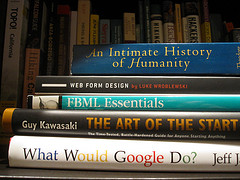
So this month, I’m going old school and reading physical books. Fortunately, Santa was good to me this Christmas, and my bookshelf is full. Here’s what’s up this month:

An Intimate History of Humanity by Theodore Zeldin. Published in 1994, this book looks at history from a humanistic perspective. Rather than look at history as a series of chronological events, Zeldin looks to history to discover “How some people have acquired an immunity to loneliness,” and “How respect has become more desirable that power.” Interesting premise.

Web Form Design – Filling in the Blanks by Luke Wroblewski is considered by many to be the definitive resource for usability of the all-important point of interaction between human and machine: the web form. Consider that I am using a web form to compose and submit this blog post. You may (hopefully) use the web form below to share a comment. We use web forms for email, discussion forums, chat rooms, documents, banking and shopping. They are — for now — the primary method of interaction on the web. And yet, so few websites do them well. I’m hoping to do my part to change that.

FBML Essentials by Jesse Stay is less of a read and more of a reference guide to FBML — the Facebook Markup Language. You may hear more about Facebook from me in the not-too-distant future.

Guy Kawasaki is a former Apple Fellow and noted entrepreneur and venture capitalist. His book The Art of the Start is a guide for anyone starting anything — whether that be a new product, service, company or club. Since I’m always starting up something, I figured it wouldn’t hurt to learn from a master.

What Would Google Do? is Jeff Jarvis’ treatise on how to do business in the Age of Google. The first few sentences from the book offer a telling glimpse at the premise: “It seems as if no company, executive, or institution truly understands how to survive and prosper in the internet age. Except Google. So, faced with most any challenge today, it makes sense to ask: WWGD? What would Google do?”

My book report will follow. First I have some reading to do!

Posted on Leave a comment

SEO Basics with Scribe

SEO or “Search Engine Optimization” is the process of improving the ranking of a website or web page in organic search results. The desired outcome of higher ranking is more page visitors, based on the simple fact that most people won’t look past the first page or two of search results. If your site doesn’t show up there, the chances of organic traffic from those search results drops precipitously.

The good news is that WordPress makes the process easy with the addition of a specialized plugin service called Scribe. I’ve been using Scribe for several months now, and I’m putting together a detailed tutorial on how to use Scribe to improve a post’s search relevance. Before I jump into that, I’m going to start by covering a few basics.

First, you need a either a theme that provides support for Scribe or an plugin that adds the necessary functionality. For a great theme with built-in support, I recommend the StudioPress Genesis framework. Genesis is cleanly coded and provides built-in SEO options in the basic framework and the various child themes.

If you are using a different theme framework or have created your own, you can add the necessary functionality via a WordPress plugin. I recommend the All in One SEO Pack. There are other compatible options out there, but these are the choices I can personally recommend.

Whichever route you choose, you will see a new SEO panel in the page and post edit views, and in that panel there are three basic fields that require your attention:

  1. Title – This should be a maximum of 60 characters, and a minimum of four words. This title can be different from the page or post title. Why would you do this? The title of the page or post is what WordPress displays on the page to the visitor. Sometimes you may want to use a clever headline there, but in this field, your focus should be on the primary keywords — the words or phrases that you think people would search on to find this page.For example, the title of this post is SEO Basics, but the title in my SEO panel (which is displayed in the title bar and used in search results) is the longer SEO or Search Engine Optimization Basics.  This longer version includes two variations on the keywords, so in theory someone could search for the acronym or the full words and find this page.
  2. Description – This should be a maximum of 160 characters. The text is displayed by some search engines directly beneath the title in search results. Make this descriptive. Use keywords. And tell the visitor what they will see if they click through. Pretty simple.
  3. Keywords – These are the words or phrases that you think people would use to search for pages like this. Each word or phrase is separated by a comma.  For example, on this post I used “seo, search engine, optimization, rank, pr, ranking, search, results, wordpress, scribe” — all keywords that someone might search on and that I would like to see this page do well with.

These fields are optional, but you should complete them on every page and post where you care about search ranking.

There’s no real magic to SEO, in spite of what some SEO specialists will tell you. Create good, valuable content. Write smart titles, descriptions and use keywords intelligently. Repeat. In time, you will see your website and pages begin to climb in the ranking.

Ready for more? I’ll be posting this tutorial in multiple parts over the next week, but if you just can’t wait for more, check out this video overview of Scribe for WordPress.

Posted on Leave a comment

The Physics of Cities

Geoffrey West is a theoretical physicist at the Santa Fe Institute who has researched and studied the dynamics of large cities; how and why they grow, and the patterns that emerge. His findings are surprising.

New York Times Magazine has a great article about West’s research. West found that he can predict with 85% accuracy the average income of a city’s inhabitants or the size of their sewage system. Basically, larger cities — in spite of their unique culture — are predictably the same in almost every other measurement.

And largely, cities are more efficient and sustainable than suburban towns. The efficiencies of scale at work.

Why do people live in cities?

This excerpt from the NYT article really stuck out:

Cities are valuable because they facilitate human interactions, as people crammed into a few square miles exchange ideas and start collaborations. “If you ask people why they move to the city, they always give the same reasons,” West says. “They’ve come to get a job or follow their friends or to be at the center of a scene. That’s why we pay the high rent. Cities are all about the people, not the infrastructure.”

This reminded me very much of what I like to say about knowledge management (KM): that KM is all about connecting people, and not about the “tool” (infrastructure). This is precisely why enterprises that drive their KM actvities as an Information Technology (IT) initiative almost always fail miserably.

Sharing knowledge is an exchange between two (or more) people. Technology can either assist or get out of the way.

Posted on Leave a comment

Looking for Talented Designers and Developers

Are you a talented web designer or developer? Do you have experience working with WordPress as a CMS? Room Five is growing and looking for a few good people to expand our team.

What is Room Five?

Room Five is a team of talented individuals who work together to create awesome web solutions for our clients. We do not have an office. There are no set hours, and no fixed schedule. Our team members are located around the country, and come together to make magic on our projects online.

Each project is assessed and assigned based on your availability and the specific needs of the client. Some of our team members work or go to school full or part-time. For them, Room Five provides a perfect way to get involved on interesting, challenging and rewarding projects on a schedule that works for them.

Intrigued? Send an email to jeff.hester@gmail.com with a brief description of your experience and how you can contribute to the Room Five team.

Posted on 2 Comments

My 50-Word Bio

I’m submitting an abstract to speak at the APQC knowledge management conference in May 2011. As part of the submittal process, I had to write a 50-word bio.

Here’s what I came up with:

Jeff Hester is passionate about communities, working with leaders, employees and developers to help them deliver business value through KM. Co-author of three books and frequent speaker, the combination of engineering background and dot-com experience give him a unique ability to bridge the gap between practice and theory in plain English.

Whatever you think about my bio, I had a few observations about the process that anyone can benefit from.

  1. Telling someone who you are in 50 words or less is challenging. There’s a lot that goes unspoken in that bio.
  2. This bio was clearly  tailored to the audience (the knowledge management crowd). If I were speaking on WordPress or backpacking the JMT, the bio would look decidedly different. This doesn’t change who I am; it simply acknowledges that I am multi-faceted. They key point? Know your audience.
  3. It was fun! You may not plan to speak at a conference anytime soon, but having a clear statement about who you are and what distinguishes you from the rest of the pack is an exercise worth doing. Think of it as an elevator pitch for YOU!

Oh, and in case you counted, I came  in one word under fifty (not counting my name). Better to come in under budget.