

There’s a lot of talk these days about unplugging and disconnecting. This music video captures the problem quite well. We more connected than ever, and yet…
Love the old-timey animation from Steve Cutts. Now turn off your phone and take a hike.
There’s a lot of talk these days about unplugging and disconnecting. This music video captures the problem quite well. We more connected than ever, and yet…
Love the old-timey animation from Steve Cutts. Now turn off your phone and take a hike.

This week I ran across two videos that you should watch. They paint a rather bleak view of technology and how it’s not really helping us become more connected. Not that this is the fault of technology. We are (I’m painting with broad strokes here) misusing technology.
The first is titled The Innovation of Loneliness. Based on Sherry Turkle’s book Alone Together (affiliate link), this video suggests that we are using social media to collect connections, rather engage in deeper, meaningful communication. We are curating our personal brand rather than interacting with transparency, openness and vulnerability.
The second video is titled I Forgot My Phone. It focuses on our fixation with these little devices that have invaded our every waking moment. What’s telling is the title itself. Is Charlene making a personal choice to not use her phone, or did she–as the title suggests–simply forget her phone?
In his book You Are Not a Gadget
Where are you on the social spectrum? Are social tools and technologies helping you build deeper, more meaningful connections? Or do these short videos ring true?
 Collaboration. Do it well, and it can improve the quality and velocity of results. Many of us collaborate on a routine basis, and have done so for years.
When I first began working, collaboration largely involved face-to-face interaction. Asking a colleague a question; getting feedback; informing decisions. Today, networks have transformed collaboration, enabling us to share our expertise and make virtual connections across the world.
I am researching how enterprises are collaborating in 2013, both inside and outside the firewall, and I need your help.
If you work for a company, organization or institution and routinely collaborate either internally or externally, take 5-10 minutes to answer this short, eleven question survey.
I will aggregating, anonymizing and share the results.
Take the 2013 Enterprise Collaboration Survey now, and share with your network.
 Twitter is increasingly a popular way to connect with experts across a variety of fields. Finding the people you know is easy enough, but how do you discover people who are actively tweeting about the topics you’re interested in? For me, I’m interested in a number of subjects, but of particular interest is the field of knowledge management — helping connect people to share and leverage knowledge and expertise.
On the subject of knowledge management, MindTouch has attempted to do just that — creating an annual list of the Top 100 Influencers in KM. While I’m honored to be included on the list (at #53), I should point out that it’s far from perfect. The list evaluates Twitter users, based on their use of the #KM and #KMers hash tags. If you’re a key influencer who does not use Twitter, you’re not on the list. If you’re a key influencer who doesn’t use the key hash tags, you’re also not on the list (sorry @elsua).
Continue reading Knowledge Management on Twitter: Who to Follow
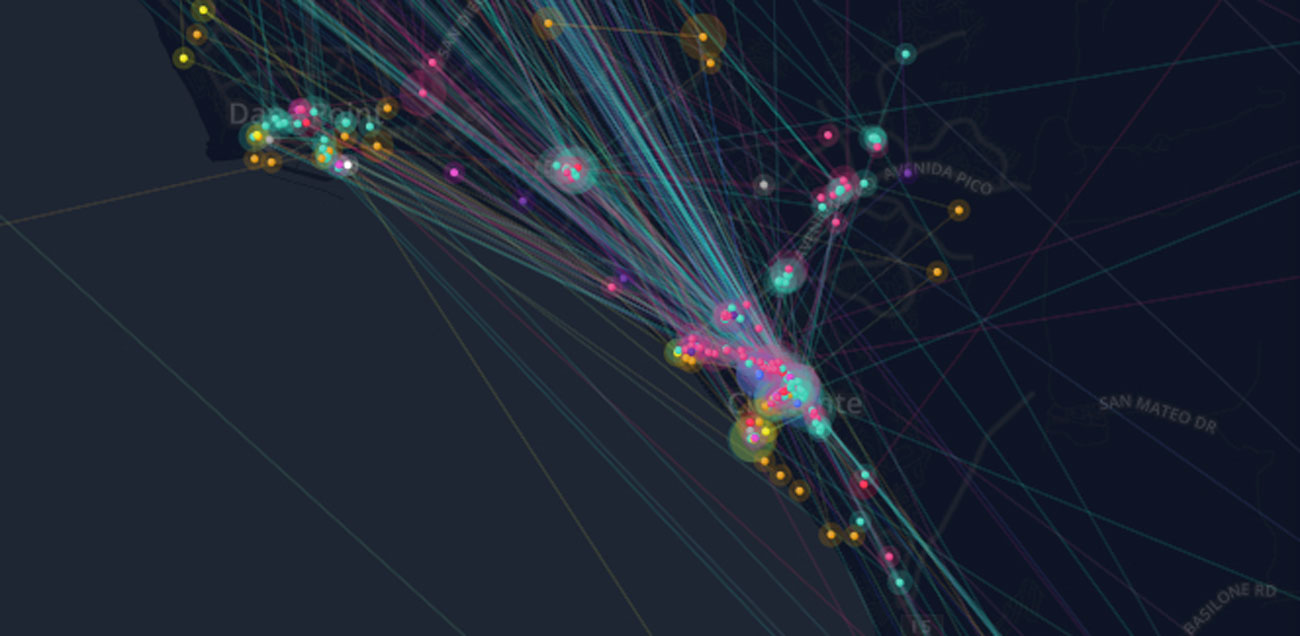
 I’ve been using the location-based social network Foursquare since 2009. Although it will come as no surprise to those who know me, my first check-in was at a Starbucks — although I was surprised to find it was in West Hollywood.
Since then, I’ve checked in 4,456 times, across the United States and around the world. What does this look like? Foursquare put together a Time Machine that takes you on a visual tour of your check-in history. Here’s what mine looked like:
I know some of you see Foursquare as a waste of time. I’ve found it useful, if for nothing else, as my digital memory. When my wife asks me, “What was the name of that souffle place in Paris that we loved?” I can tell her. And because I’ve used Foursquare regularly over the past four years, there’s a lot that the data says about me.
The Time Machine not only produces a slick animated history with an semi-annoying soundtrack, it also cranks out the requisite infographic. I’ve broken it into chunks to share my analysis.
First, there’s a heat map that shows where most of my check-ins have occurred. From 2009-2012, I lived in south Orange County, so this doesn’t really surprise me. You can see regular visits to places in Dana Point, as well as my work in Aliso Viejo.

Each of the colors represents a different kind of location. By far, most of my check-ins have been at restaurants and coffee shops. But the top spot goes to the office.
The category with the fewest check-ins is college and education. Again, since I’m not a full-time student, not surprising. When you look at the breakdown by year, you’ll notice a big growth in the number of outdoors and recreation check-ins. While I’ve always been active outdoors, I haven’t always made a point of checking in (you go outdoors to unplug, right?). Apparently my view has shifted.

My favorite place? No question about it — Starbucks. I’ve logged 830 coffee shop checkins. And my favorite food? The data says I love Mexican food best, followed closely by… tacos? Go figure.

When you look at patterns in activity, you’ll see that I most often grab a caffeine fix before heading to the office.

I was disappointed that their map didn’t show my international travel. But I have done a fair amount of travel around the country. My most visited cities? Where I live or work.

Not anything that I don’t have a pretty good general feel for. I like coffee (especially Starbucks) and Mexican food. I have been pretty consistent about checking in. And if marketers want to mine this data? Have at it. I’ll be watching my mailbox for invitations to coffee and tacos (I am, after all, a loyal customer).
What I love about Foursquare I’ve touched on before. I have a chance to share my experience with others. I learn from the experience of others (“try the french toast!”). And I have a virtual diary of where I’ve been, and when. That has proven useful to me personally over and again, and remains the main reason I continue to use Foursquare. Your mileage may vary.
If you’re a Foursquare user, give the time machine a spin yourself. And let me know what you think about living out loud, geographically-speaking.


It’s easy to pick on the cable company. Most of them are easy targets for derision. The services are overpriced and the customer service often ends up the butt of jokes.
I’ve had my own ups-and-downs with my current cable company — Time Warner Cable. Most recently, this centered around a single episode of a single show: Homeland, Season 2, Episode 11.
I have been catching up on the Homeland Season 2 replay on Showtime, recording episodes using a Season Pass on TiVo. For whatever reason, episode eleven eluded the long arms of my HDR while we were away in Sonoma. My challenge? How to legally get the missing episode.
The first option would normally be to use the on demand functionality provided through TWC. Unfortunately, because I use a TiVo box with a cable card, the on demand functionality is not available.
HBO has a great app for the iPad that lets you view pretty much any episode of any of their series, going back for years. You can even view it via AirPlay and your Apple TV. Too bad Homeland is on Showtime. Fortunately, Showtime also has an iPad app with similar on demand playback. Unfortunately it only works with certain cable providers — and TWC is not one of them.
Fortunately, TWC has it’s own iPad app called TWC TV which provides on demand functionality, including Showtime series (if you’re a subscriber, which I am). This was promising. I searched for Homeland, found Season 2, clicked on Episode 11, and… FAIL! It would not play. Check episode 10. That works. Episode 12? That also works. Episode 11 is the only episode that won’t play.
Calling TWC customer service led to the typical, unfulfilling canned responses. “Are you able to play other episodes?” Yes. “Have you tried the on-demand feature on your TV” No, I cannot because I use a cable card and a TiVo, not a cable box. “Have you tried reinstalling the TWC TV app?” Yes, with the same results. Finally they were able to confirm with another tech who had an iPad that they, too, could not play Homeland, Season 2, Episode 11. The answer? They would have to re-load the episode on their on-demand server, and to keep trying in a few days. I would not get any notification when (or if) it were resolved.
Two weeks later. Episode 11 will not play. In fact, it’s disappeared from the episode list entirely.

This time, a tweet was in order.
Been trying to watch Homeland S02E11 for two weeks. TWC cannot get it it working via their iPad app. @TWC_Help #fail pic.twitter.com/swbUxEJe3k
— Jeff Hester (@jeffhester) April 18, 2013
Next, TWC is calling me, to help sort out the problem Again, we repeat the dance. “Are you able to play other episodes?” Finally, I get them to realize (again) that the problem is with that particular episode on their server. And again, the solution? Wait a few days and try again.
Frustrated, I finally decide to bring the cable box out of the closet, dust it off and hook it up. Had to dig out a couple coaxial cables and a splitter, and add to the tangle of cables. Finally, it’s all hooked up. Fire up the cable box, press the “on demand” button and… FAIL. Ugh.
One more phone call to TWC support, and they send a signal to the box. Finally it’s working (though still not on the TWC TV app).
There’s a few lessons in this experience. First, it was interesting to note that TWC is actively monitoring Twitter. It’s a smart move for them, even though they weren’t able to actually solve the problem.
…Remember, these days, when you’re talking to one person, you’re talking to a thousand. -Zoe Barnes, House of Cards
From a consumer perspective, I got more intelligent response from a tweet than from a phone call to their toll-free customer service line. Of course I made a point of mentioning the TWC twitter account, but it got action–and more intelligent action–much faster. Social networks empower consumers.
Which leads to the more important lesson. Having responsive customer service is only meaningful if you can actually fix the problem. In this case, TWC failed. Granted, it may be fixed eventually, but they weren’t equipped to resolve the issue even after several weeks. It’s a problem of bureaucracy, and a symptom of broken processes in the organization. The real problem for TWC in this case is not one of sloppy customer service, but an inability to fix what’s broken with their own internal processes.
All of this begs the question: What’s broken in your company? In your organization? In your life or relationships? If the experience sucks, something must change. Fixing the problem involves change. Embrace the change.
Insanity: doing the same thing over and over again and expecting different results. – Albert Einstein
For what it’s worth, I was finally able to watch Homeland, Season 2, Episode 11 last night. And yes, it was worth it.
Photo credit: Nickwheeleroz on Flickr


Have you been to a PechaKucha Night? These lively events feature short, six-minute presentations with precisely 20 slides — each slide displayed for 20 seconds–20×20. It’s been adapted by other groups such as Ignite (who uses a 20×15 format). One of the wonderful things about these events are the energy and fun. The 20×20 cadence requires presenters to be concise and really get to the salient points. And conversely, if a speaker sucks, the suffering only lasts for six minutes.
I’ll be presenting tonight at the first quarterly PechaKucha Night Fullerton. Interested in joining a group of smart, artistic, creative and thoughtful folks? Get all the details.