
One of the wonderful things about an iPad is that you can take your virtual library with you where ever you go. Spare moments become opportunities to catch up on reading. I’ve got three different e-readers: the Apple iBooks app, the Amazon Kindle App and the Google Books app.
iBooks is great for storing and reading PDFs, and I’ve ended up with a collection of user guides and work-related papers there. Google Books is interesting, and free, but I have yet to purchase anything or even seriously read anything with it. So far the Amazon Kindle app has been my favorite. The price of Kindle books tends to be a little cheaper than iBooks for some reason, and the reader works great.
Recent Reads
Over the holidays I managed to burn through three books (all consumed via the Kindle app):
UnMarketing: Stop Marketing, Start Engaging by Scott Stratton is a great read on how to leverage social media as a way to engage and build relationships with your customers. Instead of shouting to them from a soapbox, engage them in a conversation.
Keith Ferrazzi’s Never Eat Alone: And Other Secrets to Success, One Relationship at a Time is a few years old, but the stories and experiences he shares still piqued my interest. Ferrazi came from humble beginnings and went on to do quite well. He chalks it up to the power of connecting to people. Not using them, but building genuine relationships that are mutually beneficial.
The 4-Hour Body was written by Timothy Ferriss, author of the New York Times bestseller The 4-Hour Workweek. It’s designed to be read in sections, picking in choosing based on your own goals and objectives. His views are provocative — he’s a big fan of pharmaceuticals — and I’m still chewing over his ideas.
One of the observations after reading these books on my iPad is that while it’s wonderful to have a selection of books with me at all times, the experience of working through a book is less satisfying. I mentioned this to my girlfriend (a Kindle fan) and she agreed. You don’t get the tactile satisfaction and immediate appreciation for where you are in the book. Yes, I know that there are visual cues like the little slider at the bottom of the screen, but it doesn’t replicate that feeling you get as the pages ahead become fewer and lighter.
My January Reading List
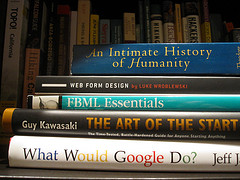
So this month, I’m going old school and reading physical books. Fortunately, Santa was good to me this Christmas, and my bookshelf is full. Here’s what’s up this month:
An Intimate History of Humanity by Theodore Zeldin. Published in 1994, this book looks at history from a humanistic perspective. Rather than look at history as a series of chronological events, Zeldin looks to history to discover “How some people have acquired an immunity to loneliness,” and “How respect has become more desirable that power.” Interesting premise.
Web Form Design – Filling in the Blanks by Luke Wroblewski is considered by many to be the definitive resource for usability of the all-important point of interaction between human and machine: the web form. Consider that I am using a web form to compose and submit this blog post. You may (hopefully) use the web form below to share a comment. We use web forms for email, discussion forums, chat rooms, documents, banking and shopping. They are — for now — the primary method of interaction on the web. And yet, so few websites do them well. I’m hoping to do my part to change that.
FBML Essentials by Jesse Stay is less of a read and more of a reference guide to FBML — the Facebook Markup Language. You may hear more about Facebook from me in the not-too-distant future.
Guy Kawasaki is a former Apple Fellow and noted entrepreneur and venture capitalist. His book The Art of the Start is a guide for anyone starting anything — whether that be a new product, service, company or club. Since I’m always starting up something, I figured it wouldn’t hurt to learn from a master.
What Would Google Do? is Jeff Jarvis’ treatise on how to do business in the Age of Google. The first few sentences from the book offer a telling glimpse at the premise: “It seems as if no company, executive, or institution truly understands how to survive and prosper in the internet age. Except Google. So, faced with most any challenge today, it makes sense to ask: WWGD? What would Google do?”
My book report will follow. First I have some reading to do!


 This weekend I had the pleasure of meeting screenwriter and novelist Rex Pickett, perhaps best known for his novel Sideways (and the film by the same name).