Posted on 4 Comments

What is Personal Knowledge Management?

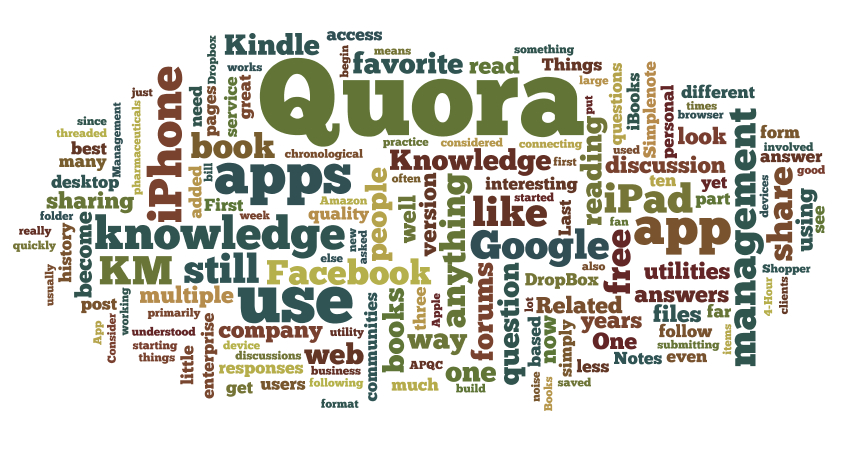
A word cloud generated from my RSS feed

Earlier today I participated in the weekly KMers.org tweet chat. This week’s discussion was hosted by Kate Bower, discussing the role of self management and self regulation in personal knowledge management (PKM). There was some dissent as to whether PKM required a certain level of obsessive compulsive disorder — OCD — or whether there it was possible to use more of a mad scientist approach to PKM.

To answer the question, you must first define personal knowledge management. What exactly is PKM?

Wikipedia defines PKM as: “a collection of processes that an individual carries out to gather, classify, store, search, retrieve, and share knowledge in his/her daily activities and how these processes support work activities.”

In my view, there are three dimensions to personal knowledge management.

First, you need an awareness of your knowledge. You have to know what it is that you know. This is challenging for many people, whether out of modesty or a lack of self-awareness, but technology is helping. Tools like desktop search and word clouds can help surface the subjects that we have a keen interest in — our likely areas of expertise and knowledge.

Next, you need to be open to learning. Equally important to knowing what you know is knowing what you don’t know, and being open to learning and growing. None of us have a monopoly on knowledge. Some might argue that PKM devalues the need for knowledge sharing with others, but the opposite is closer to the truth. As we understand what we know — and do not know — we see where we can contribute to the larger group. At the same time, we see how we can leverage the knowledge and expertise of others in that group where we have gaps in our own knowledge.

Finally, you must be open to sharing. Unless your tacit knowledge is applied, is it really knowledge at all? What is the value of knowledge that goes unused and unshared?  And the beauty of knowledge sharing is that there is an infinite supply. If I give my knowledge to you, I still retain possession. It’s simply multiplied.

As personal knowledge is shared, the entire organization grows and benefits.

During the course of our chat, several members (myself included) described their approach to PKM as that of an mad scientist. I’m not particularly rigorous about folders, hierarchy and information organization. I’d much prefer to leverage technology to help percolate my knowledge to the top.

There are two excellent tools that can help with this.

First, personal search. Simply being able to search my hard drives for the information is often much faster than navigation down a series of folders, especially since search can look beyond file names into the actual content. Search is built into both my Windows 7 PC and my Mac. For email, I use Gmail, which provides super-fast searches through my entire email archive. There are also third-party search tools that will index your hard drive, but I’m quite content with the simplicity of the built-in search.

A word cloud generated from my Delicious bookmarks

Second, word clouds. Wordle.net will take your blog or your Delicious bookmarks and automatically create a word cloud based on the topics that appear most frequently. Word clouds are a great way to visualize the relative importance of topics, as the size of each word is determined by the number of times it appears.

These tools are simply aids that will help you divine your interests (and theoretically areas where you might have some budding expertise). The next steps — growing and sharing — are up to you.

What does PKM mean to you, and what tools and techniques have you found useful?

Posted on 1 Comment

What is Quora, and Why Should I Care?

If you haven’t heard of Quora, you should. It’s been getting a lot of buzz. What is Quora? According to their website, “Quora is a continually improving collection of questions and answers created, edited, and organized by everyone who uses it. Quora was founded in April 2009 by Adam D’Angelo, who was previously CTO and VP of engineering at Facebook, and Charlie Cheever, who led Facebook Connect and Facebook Platform. Quora is privately held and funded by Benchmark Capital, and is based in Palo Alto, CA.”

Having been involved in discussion forums, developing online communities such as BigBlueBall as well as enterprise communities in the context of knowledge management (KM), what’s interesting to me is how Quora takes the traditional threaded discussion format and completely reinvents it, with some excellent results.

Granted, there are important differences between Quora and a discussion forum. Quora is specifically and exclusively suited to a question and answer format. Forums can serve a much broader purpose, including open discussions, brainstorming and ad hoc, asynchronous collaboration. But when you look at most forums, a large percentage of the discussions begin with someone who needs help (they have a question) and subsequent responses (answers, in the best case scenario).

How does Quora do this differently? First of all, forums typically require the participants to begin by navigating to the category that is best suited to their topic. This alone can quickly become a barrier, as the way I would categorize something might be very different than the way other people would. In Quora, you simply ask a question. You have the option of tagging a question with one or more keywords (roughly analogous to categories). Other Quora users can follow (think subscribe) specific questions if they are curious about the answer, or they can follow a tag and get notified of any activity tagged with that keyword.

Second, where forum are typically listed in either a threaded view (i.e. Slashdot) or chronological view, Quora allows the responses to be resorted. Other Quora users can vote on the best answers, and they percolate to the top.

The Q&A type site isn’t really anything new. Google tried it before, and failed. Yahoo! Answers is another service that has hung in there, but the quality is spotty. So far, the quality of the responses has really set Quora apart. It’s not uncommon to see a CEO or founder of a company jump in with a response to a question about their business model. The particpants, by and large, are a higher caliber than I’ve seen in similar systems.

What happens next? Last week at the Social Media MasterMinds meetup in Orange County, we speculated that the opportunity for Quora has already come and gone. The theory is that once it goes mainstream, the quality suffers. The noise level increases as people look for ways to “use” Quora to improve their SEO, market their company or service, or insert spam links for pharmaceuticals.

I’m still in discovery mode on Quora. I’m following a few topics — some personal (hiking) and some professional (knowledge management). I’ve voted up a few good answers, added an answer, and asked a couple questions (with mixed results so far). The process has been interesting and even useful, but the jury is still out on whether I’ll stick with it. For now, you can me find here on Quora.

If you work with forums, online communities or KM, Quora is worth looking at. Consider it food for thought.

Posted on 3 Comments

The Future of Knowledge Management

The knowledge extraction helmet

I’ve been directly involved in knowledge management — the science of collecting, sharing and leveraging knowledge — for nearly ten years, and indirectly much longer. Knowledge management, or more simply KM, is often unknown outside of the organizations who practice it. Sometimes KM is disguised with a different moniker — knowledge sharing, collaboration, team rooms, Enterprise 2.0 and so on. And among those who do practice KM, there is often a misperception that KM is a tool — a software solution.

The reality is that even after ten years of revolutionary KM, it’s still primarily about connecting people. Cutting through the digital noise and making a connection with that person whose expertise intersects with my need.

Now for the next ten years. How do you see knowledge sharing changing between now and the year 2020?

Posted on Leave a comment

The Physics of Cities

Geoffrey West is a theoretical physicist at the Santa Fe Institute who has researched and studied the dynamics of large cities; how and why they grow, and the patterns that emerge. His findings are surprising.

New York Times Magazine has a great article about West’s research. West found that he can predict with 85% accuracy the average income of a city’s inhabitants or the size of their sewage system. Basically, larger cities — in spite of their unique culture — are predictably the same in almost every other measurement.

And largely, cities are more efficient and sustainable than suburban towns. The efficiencies of scale at work.

Why do people live in cities?

This excerpt from the NYT article really stuck out:

Cities are valuable because they facilitate human interactions, as people crammed into a few square miles exchange ideas and start collaborations. “If you ask people why they move to the city, they always give the same reasons,” West says. “They’ve come to get a job or follow their friends or to be at the center of a scene. That’s why we pay the high rent. Cities are all about the people, not the infrastructure.”

This reminded me very much of what I like to say about knowledge management (KM): that KM is all about connecting people, and not about the “tool” (infrastructure). This is precisely why enterprises that drive their KM actvities as an Information Technology (IT) initiative almost always fail miserably.

Sharing knowledge is an exchange between two (or more) people. Technology can either assist or get out of the way.

Posted on 2 Comments

My 50-Word Bio

I’m submitting an abstract to speak at the APQC knowledge management conference in May 2011. As part of the submittal process, I had to write a 50-word bio.

Here’s what I came up with:

Jeff Hester is passionate about communities, working with leaders, employees and developers to help them deliver business value through KM. Co-author of three books and frequent speaker, the combination of engineering background and dot-com experience give him a unique ability to bridge the gap between practice and theory in plain English.

Whatever you think about my bio, I had a few observations about the process that anyone can benefit from.

  1. Telling someone who you are in 50 words or less is challenging. There’s a lot that goes unspoken in that bio.
  2. This bio was clearly  tailored to the audience (the knowledge management crowd). If I were speaking on WordPress or backpacking the JMT, the bio would look decidedly different. This doesn’t change who I am; it simply acknowledges that I am multi-faceted. They key point? Know your audience.
  3. It was fun! You may not plan to speak at a conference anytime soon, but having a clear statement about who you are and what distinguishes you from the rest of the pack is an exercise worth doing. Think of it as an elevator pitch for YOU!

Oh, and in case you counted, I came  in one word under fifty (not counting my name). Better to come in under budget.

Posted on 2 Comments

Communities Behind the Firewall

Last July, I spoke at the inaugural Ignite/LA on the use of virtual communities to enable strategic knowledge sharing across the enterprise. It took a while, but the video is now online.

The Ignite format uses 20 slides which auto-advance every 15 seconds making the presentation length a total of five minutes. The next Ignite/LA will be held on Monday, June 7th in Santa Monica. You can now register online.

Posted on 2 Comments

Extra-Enterprise Knowledge Management

Knowledge management is commonly understood as an enterprise initiative, usually with the objectives of collecting, capturing and reusing knowledge and expertise within the enterprise. The rise of cloud computing, social media and free collaboration tools has made it possible for communities of like-minded people to form outside the context of the enterprise — a form of ad-hoc knowledge sharing and collaboration.

Examples of such communities abound, including (in the KM realm) KMers.org, KMwaves.org and SIKM. But you don’t need to look further than Google to find a wealth of thriving community eco-systems, many with processes for identifying experts and collecting knowledge. Easy access to collaboration tools like Twitter, Skype, blogs, wikis and Google Wave provide the underlying technology that makes such collaboration possible among participants who might otherwise never meet.

It’s reasonable to suggest that real knowledge management occurs in many of these external communities, even if it isn’t really considered KM by its participants.

In this environment, each enterprise (theoretically) has its own knowledge management methodology and systems. In addition, each external community (i.e. KMers.org) also has their own methodology and systems… and community. A professional at Partner C can collaborate and share knowledge within their own enterprise, and/or within any number of external communities. But they remain separate systems. When internal knowledge and expertise comes up short, he must repeat the process (if he’s motivated) in whatever external communities he is involved in.

Extra-Enterprise KM

What I am interested in exploring is what I’ve termed extra-enterprise knowledge management. This involves tightly coupled KM shared within a known group of enterprises, and ideally with integration to traditional intra-enterprise KM systems.

In this environment, there remain internal KM processes and tools, but with strong connections to other valued enterprises — clients, partners, suppliers and in some cases even competitors may fit the bill. The professional in Company A can begin their search for knowledge or expertise within their enterprise, but can also extend that to include the community that “lives” at the intersection of the participating enterprises. It’s KM beyond the firewall.

This happens today in small groups, and generally through personal networking (who you know). I’d like to extend this to the broader enterprise.

There are numerous obstacles and questions that must be resolved to make this a reality. There are legal and regulatory problems, technical issues, and culture clashes, each of which I will explore in the future. But extra-enterprise KM holds tremendous promise for extending and leveraging knowledge sharing and collaboration. Whatever it is called, it’s the next wave of KM.

Interested in continuing the discussion? I am moderating a Twitter chat event titled KM Beyond the Firewall at KMers.org on March 9, 2010 at noon EST.